The Pattern of History and the Quest of the Soul
Dublin Core
Title
The Pattern of History and the Quest of the Soul
Source
Personal collection of David Kay.
Publisher
Madrian Literature Circle
Date
c. 1980
Language
English
Type
Text
Text Item Type Metadata
Text
The Pattern of History and the Quest of the Soul
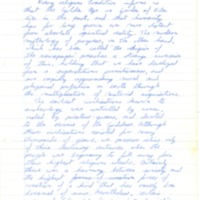
Every religious tradition informs us that the Golden Age or Garden of Eden lies in the past, and that humanity has for long grown ever more distant from absolute spiritual reality. The modern mythology of progress, on the other hand, which has been called 'the religion of the newspaper' preaches a strange inversion of this, holding that we have developed from a superstitious primitiveness, and are rapidly approaching moral and physical perfection on earth through the multiplication of material acquisitions.
The earliest civilisations known to archaeology were controlled by women, ruled by priestess-queens, and devoted to the service of the Goddess. Although these civilisations existed for many thousands of years, we possess relics only of their declining centuries when the people were beginning to fall away from their highest religious ideals. Certainly there was a harmony between society and the highest forces of creation of a kind that has rarely been dreamed of since. Nevertheless, certain areas of life were becoming 'secularised': certain elements of materialism were creeping into popular thought and practice, and although these were so far removed from the materialism of our own time that a modern mind might well think of them as forms of the highest spirituality, nonetheless the earliest ideals, which saw the whole of society as one great temple to the Goddess, and all of life as a single and exuberant act of devotion, were declining. And with this decline came a corresponding decline in cultural achievement.
Even when the decline had gone so far that nomadic patriarchal tribes from the east had been allowed to make considerable inroads into religious thought, and a second wave of more savage patriarchal invaders had found it possible to overrun large areas, suppressing matriarchy and introducing the cult of the male god of wrath – even at this stage, those states which remained matriarchal maintained a culture whose remains have provoked effusive tribute from even the most soberly academic of historians. Thus, comparing matriarchal Crete with the surrounding male-governed states, the normally unenthusiastic Harold Hauser writes "...what a difference in the whole conception of art! What freedom in artistic life in contrast to the oppressive conventionalism of the rest of the Ancient-Oriental world!" While the art-historian Mrs. Groenwegen Frankfort writes "Here and here alone, the human bid for timelessness was disregarded in the most complete acceptance of the grace of life the world has ever known." Jacquette Hawkes describes the queen-priestess's [sic] palace at Knosses as having "...a residential style, a domestic civility and convenience that seems to anticipate European palaces of the Renaissance and after rather than imitating its contemporaries in Egypt and the Orient." In the language of progressism, it was some three thousand years 'ahead of its time'!
Yet perhaps more important than all these things are the qualities which the matriarchate lacked. Miss Hawkes has described how contemporary male rulers surrounded with huge painted scenes of battle and bloodshed. Prisoners bound and writhing, severed hands and severed heads are displayed not only on paintings covering walls and stairs, but also in a great variety of carved objects. This form of decoration – the glorification of violence which has characterised the patriarchate through practically all of its existence – is found not only in contemporary Europe and the Orient, but as far afield as Central America. "And yet in Crete," writes Miss Hawkes, "where hallowed rulers commanded wealth and power and lived in splendid palaces, there was hardly a trace of these manifestations of masculine pride and unthinking cruelty."
The difference between these two cultures is best expressed by saying that one was a spiritual culture and the other is a material culture. In one culture, even the architecture expresses the 'grace of life'. In the other culture, even the Supreme Being is represented as an oriental potentate. It is true that at certain times the later religions did recapture certain of the truths of the original religion. Nevertheless, there is a fundamental difference between the two kinds of religion which is expressed in a very profound symbol – the unpronounceable Name of the Goddess. This Name is represented by the three letters I H V (the Trigrammaton). When the earliest priests of the patriarchate set out to masculinise the Godhead, they did a very revealing thing: a thing which, consciously or unconsciously, symbolised the inmost nature of the culture which was to dominate the world for the next five thousand years. They added one letter to the Trigrammaton, thus forming the Tetragrammaton, I H V H. Deity was no longer expressed by the spiritual number three, but by the material number four. The full significance of this can best be understood in the light of the spiritual history of that group of souls which make up humanity.
When intelligent creation first turned from the Goddess, the universe was translated from the sphere of ideal forms or Divine thoughts into the realm of matter which includes not only the level of dense material which we call the physical world, but also the etheric and other subtle planes. This separation from the Goddess was not to be permanent, but as by her own choices and actions the child had strayed, so, if she was to retain her essential freedom, by her own choices and actions she must return (it is to make this possible that the holy Maid has come to us). At this time all souls were at a much higher level than now, living on the subtlest planes and still very close to the Goddess. Since then every soul has taken its own direction – some descending to lower planes to incarnate in human form, others coming back into union with the Goddess, and multitudes of others moving through every level of existence from the lowest to the highest.
Life on earth, too, has been subject to continual change. At the beginning humanity was still close to the higher realms, sensitive to etheric currents, and to the mental and emotional vibrations of others, able to see 'spiritual' entities and to bring about changes in physical matter by a simple operation of the will.
The powers of individuals have never been uniform, and at every time there have been some possessed of the highest faculties; but there is always a general level, and because of the sensitivity of the individual soul to the psychological atmosphere about her, she is rarely able to rise very far above that level. In our own time the level is very low. At the height of the last matriarchal period, however, humanity reached a peak of achievement. Both culture and human faculties were brought to a high point of refinement. It is difficult to describe exactly what took place at that time; but one way of putting it is to say that idea was much closer to actuality than it is now. All our actions begin with an idea and consist of the attempt to bring that idea into actuality. In the Divine Mind, every idea is at once actuality – that is what we mean by Divine creation. We are told that in the beginning 'the daughters of the Goddess' – intelligent creation – possessed a measure of this divine prerogative. As a creature grows further from her Goddess, so her ideas and her actuality grow further apart. We may also say then that humanity had in the period of which we are speaking come very close to the Goddess – for the more a soul is in harmony with Divinity, the more she is in harmony with all things, and the more all things harmonize [sic] with her will. This is the highest meaning of magic.
This high level of culture was attained by the dedicated cultivation of the spiritual. The ideal of beauty was applied to every area of life, for only the beautiful was fit for a gift to the Goddess; and all life was to be given to Her. The ideal of perfection governed everything – from the tallest building to the briefest gesture of the hand, each thing must achieve perfection after its own kind.
When this is understood, we may see how a decline was possible. Why should those who have a complete magical control over the things about them ever choose to lapse from that state? Why should the choose hardship and effort in place of a life of sublime grace? Because the effort entailed in maintaining themselves at this level was inconceivably great. Because the closer we come to the Goddess, the more She demands complete perfection. We are released from the physical demands of life that we may meet demands of a higher and purer nature whose fulfillment is immeasurably more satisfying than anything we now know, but also immeasurably more difficult. Our Lady demands that we become the perfect and resplendent creatures that we were when She first created us. She leads us patiently, step by step; She does not at any time demand more of us than we are able to perform – but neither does She demand one whit less. Our Lady is pleased beyond measure with our first faltering turning to Her. She is delighted with every loving act and each small sign of progress. But She is only satisfied with perfection.
There can be no standing still on this path. Either one is moving forward or one starts to slip back. As soon as one ceases to make moral effort, idea and actuality begin to drift apart and the psychic and magical faculties begin to lose their sharpness. This is not a punishment any more than the faculties themselves were a reward; it is a simple matter of cause and effect. Where idea and actuality separate, the world becomes for all practical purposes more 'solid'; its material is more intractable; and we are increasingly driven to the use of physical intermediaries between ourselves and the matter which we would affect rather than the direct employment of the will. At its most sophisticated the use of such intermediaries becomes an advanced technology. It is ironic that such technologies are claimed to increase human control over the environment, for while in one sense that is certainly the case, in the deepest sense the reverse is true. The exclusive study of the 'objective' physical conditions of the world brings about precisely the psychological conditions which promote the continuing 'solidification' of matter. It also tends to foster an attitude of mind which precludes any serious spirituality and therefore drives people yet further from the Goddess, Who is the fount and source of all creative activity.
Must we say, then, that the achievement of the matriarchal age has been completely lost? No, for not only did that period help many souls to refine themselves until they could leave the world and continue their upward journey in the heavenly spheres, but also, every true aspiration to perfection is a precious creation that continues to exist in a realm beyond time and place.
This is another and more immediate question which emerges from our brief survey of the pattern of history: for those of us who have remained in the lower planes and in the cycle of reincarnation, is it much harder in this present age for us to come closer to the Goddess? There is a twofold answer to this question. In the first place, it is true that insofar as we have drifted further from out Lady we have a greater distance to return. But it is also true that the farther we stray from the light the fainter it becomes until we can no longer see it at all, and must be lost to flounder in eternal darkness; or even if we should catch a glimpse of it, the tiny increase of brightness which would come from much arduous striving toward it would be of such small comfort to our souls that we could not find the courage to continue.
That, in the nature of things is the situation in which we must find ourselves. And yet so great is the love of our Lady for Her children that She could not allow it to remain so. She must come to the assistance of Her children. But how can She, Who is pure unbounded energy and abundance come into a place tinged with restriction and limitation? To put it another way, how can She, Who is pure good, come into a place which contains evil? How, in short, can She come into that place which by its very definition is that-place-where-She-is-not?
The nature of that problem is made more difficult for us to understand by the fact that we think mostly in the language of the materialist culture. One the material plane it is easy for a mother to pick up her straying child and carry her back home. She compels the body, but she does not compel the soul. She picks up the body and puts it where it ought to be, but she cannot pick up the mind and put it where it ought to be. She cannot make the child think what she ought to think, feel what she ought to feel, like what she should like and dislike what she should dislike. The mother can teach and encourage the child, but she cannot do these things for her – if she could the child would quite literally cease to have a mind of her own. We could not speak of it being for the child's own good, for the child would simply have ceased to exist as a person.
Now on the spiritual plane there is only soul – we have no body that may be carried. Our Lady cannot take us to Her, for is She did so, She would destroy the essential freedom which gives us our existence as intelligent personal beings. We must come to Her of ourselves.
It may be asked why She may not come to us, but this too is a question born of material ideas – for coming and going are the only ways of speaking, for there is neither time and space in the spiritual world. The choice that each of us has made from the beginning of our separation was that we should be apart from the glory of Her light and energy. She cannot annul that choice without annulling our personal existence. The distance between ourselves and the Goddess is not real space, but the outward spiritual manifestation of our inward spiritual rejection of Her.
It was necessary, then, that She should come to us shorn of the glory of Her light and energy; that She should put Herself on the same spiritual plane as us by making the same choice that we have made – by rejecting Herself. Thus She came to us in the person of Her Daughter. The coming of our Lady is symbolised in the story of Her nativity, and the terrible Act of divine self-rejection in the story of Her passion and death. We cannot ever understand the full meaning of this Act, but some insight may be gained by meditation upon these words from the Easter [sic] Liturgy:
She Who is life and life alone, the quintessence of life,
Went to death for our sakes;
She Who is all and only light
Gave Herself to be cast into the profoundest darkness;
She, Who is wholly one with the Mother, and is the Mother,
Who is the glance of Her eyes and the breath of Her mouth,
And the strength and cunning of Her hands;
She alone suffered the most terrible severance
That we might be reunited.
Through this sacrifice has our Lady come to us so that we need not be without Her love even in the lowest depths of fallen creation, and even when we cannot open our eyes to Her light, we have but to stretch out a hand with faith into the darkness and it shall be taken by another hand infinitely strong and infinitely gentle; the hand of One Who has suffered more deeply than we can ever suffer; the hand that shaped the universe.
The answer to our question, then, is that we are in any age able to turn to our Lady and to receive Her love, 'so far as we are able to contain it'. Nevertheless, it is certainly true that it is ever harder to turn to Her and to keep Her image before us as we are increasingly surrounded by a leaden atmosphere of dull materialism and receive no encouragement on any side. Materialism has increased throughout the history of the patriarchate. Although it has been a continuing process there were two major religious shifts. The first was when Christianity replaced the Classical religions – the patriarchate could no longer understand a purely spiritual account of divine Actions, and had to imagine that the divine Sacrifice was an actual historical event – also with this went the worship of our Lady under the names of the classical Goddesses. The second was the so-called Reformation – attuning of Christianity to the mechanistic minds of those who initiated the factory system; over-urbanisation and all the other trappings of the last phase of materialism – along with this went the destruction of the worship of our Lady under the name of Mary.
It may seem, then, that this flight from the Goddess into materialism might continue forever, and that the souls caught up in its current might be eternally lost. To earthly eyes it may appear so; but in its final stages, the advance of materialism falls subject to a law stated in the Oracle of Changes thousands of years before the dawn of the patriarchal age. This is the law of Climax and Reversion which states that as any temporal movement reaches its point of greatest extension it begins to change into its opposite. We can see how this works in the case of patriarchal religion: the rationalistic spirit of its most extreme form has increased to the point where it has destroyed its own beliefs and ushered in a period of general irreligion – with protestantism [sic], the destructive vibration of Christianity reaches the point at which it shakes itself apart. Yet all the values of civilisation have their source and meaning in religion – divorced from this source, they are but empty husks to be swept aside by the criticism of alienated minds which are brilliant in their destructiveness, but can offer no positive solutions. They speak of 'social conscience', but cannot answer the question of why there should be a society in the first place; they talk of 'human happiness' but cannot say why human beings should exist at all, or what a human being is – how much less can they know in what true happiness might consist. Their 'science' can answer the question 'how' with considerable accuracy (thought even here its limits are severely marked) but it cannot even ask the question 'why'. Life divorced from an understanding of its religious meaning becomes increasingly purposeless and void; that is what is happening to the present society – with irreligion the snake of patriarchal-materialism bites it own tail and begins to devour itself.
There is a still deeper reason why we cannot be carried downward forever on the tide of materialism; it is also the profoundest reason why no soul can ever be lost. Because this concerns the highest spiritual truths, it can only be expressed in a symbol. We are told that the highest state of existence consists in beholding the perfect beauty of our Celestial Mother; living in the Divine Image. As we move away from Her, existence becomes less and less like that image until, should we go as far from Her as it is possible to go, at the 'bottom of the universe' we should see a vision so dreadful that to compare it to the most hateful nightmare of high fever were but to make a mockery of it. It is the absolute reverse of our Mother's image. This vision is the most terrible shock that the created soul can sustain; yet although it is an experience of unmitigated horror, its evil is turned to a good purpose, for at the sight of the true face of Evil, every soul is filled with loathing, and must turn to flee back our Lady. This is the final safeguard against 'damnation' for no soul, seeing evil in its absolute form, can fail to hate it. The absurd doctrine that Deity will allow the soul to lose her essential freedom at this point so that she cannot turn, but must suffer eternally is the cruellest of all blasphemies. Though she has the furthest possible distance to travel to her Mother, yet the Daughter, who, through Her sacrifice, has penetrated even to the lowest depths, is waiting to comfort her, and to help her upon her way.
This is not to suggest, of course, that human society has collectively plumbed the uttermost depths of Hell, for this can only occur to the individual soul. But a shadow of that awful vision is creeping across the modern mind, and some of the more sensitive souls are already experiencing a revulsion from it. In this revulsion, they are turning again to our celestial Mother. And it is here that we see the true miracle of our Lady's grace. It is part of Her promise that those who love Her shall never lack a way to turn to Her. The most perfect way in which an earthly creature may turn to Her is by participation in Her divine sacraments, but when, due to the laxity of Her servants, these were suppressed by Her enemies, She was called by the names of the pagan Goddesses. When these too were suppressed, She too for us the name of Mary, Maris Stella, Regina Coelis. When this cult was suppressed, still there were the folk-beliefs and popular Marian devotion. And now even that is taken from us, the darkest hour seems upon us – but look again. The light has not vanished, but grows stronger; the sacraments themselves are openly performed once more. The wheel has reached its point of farthest extension and can but return. The waxing has begun.
---
Note: The term 'spiritual world' used in this paper should not be confused with the 'spirit world' of the mediums which might more accurately be called the 'psychic world'. It refers to the highest plane of fallen existence which intersects with the lowest plane of perfect existence. The most refined souls have their whole being in this sphere, but all actions of intelligent souls on any plane have spiritual significance and therefore operate also in the spiritual world.
Every religious tradition informs us that the Golden Age or Garden of Eden lies in the past, and that humanity has for long grown ever more distant from absolute spiritual reality. The modern mythology of progress, on the other hand, which has been called 'the religion of the newspaper' preaches a strange inversion of this, holding that we have developed from a superstitious primitiveness, and are rapidly approaching moral and physical perfection on earth through the multiplication of material acquisitions.
The earliest civilisations known to archaeology were controlled by women, ruled by priestess-queens, and devoted to the service of the Goddess. Although these civilisations existed for many thousands of years, we possess relics only of their declining centuries when the people were beginning to fall away from their highest religious ideals. Certainly there was a harmony between society and the highest forces of creation of a kind that has rarely been dreamed of since. Nevertheless, certain areas of life were becoming 'secularised': certain elements of materialism were creeping into popular thought and practice, and although these were so far removed from the materialism of our own time that a modern mind might well think of them as forms of the highest spirituality, nonetheless the earliest ideals, which saw the whole of society as one great temple to the Goddess, and all of life as a single and exuberant act of devotion, were declining. And with this decline came a corresponding decline in cultural achievement.
Even when the decline had gone so far that nomadic patriarchal tribes from the east had been allowed to make considerable inroads into religious thought, and a second wave of more savage patriarchal invaders had found it possible to overrun large areas, suppressing matriarchy and introducing the cult of the male god of wrath – even at this stage, those states which remained matriarchal maintained a culture whose remains have provoked effusive tribute from even the most soberly academic of historians. Thus, comparing matriarchal Crete with the surrounding male-governed states, the normally unenthusiastic Harold Hauser writes "...what a difference in the whole conception of art! What freedom in artistic life in contrast to the oppressive conventionalism of the rest of the Ancient-Oriental world!" While the art-historian Mrs. Groenwegen Frankfort writes "Here and here alone, the human bid for timelessness was disregarded in the most complete acceptance of the grace of life the world has ever known." Jacquette Hawkes describes the queen-priestess's [sic] palace at Knosses as having "...a residential style, a domestic civility and convenience that seems to anticipate European palaces of the Renaissance and after rather than imitating its contemporaries in Egypt and the Orient." In the language of progressism, it was some three thousand years 'ahead of its time'!
Yet perhaps more important than all these things are the qualities which the matriarchate lacked. Miss Hawkes has described how contemporary male rulers surrounded with huge painted scenes of battle and bloodshed. Prisoners bound and writhing, severed hands and severed heads are displayed not only on paintings covering walls and stairs, but also in a great variety of carved objects. This form of decoration – the glorification of violence which has characterised the patriarchate through practically all of its existence – is found not only in contemporary Europe and the Orient, but as far afield as Central America. "And yet in Crete," writes Miss Hawkes, "where hallowed rulers commanded wealth and power and lived in splendid palaces, there was hardly a trace of these manifestations of masculine pride and unthinking cruelty."
The difference between these two cultures is best expressed by saying that one was a spiritual culture and the other is a material culture. In one culture, even the architecture expresses the 'grace of life'. In the other culture, even the Supreme Being is represented as an oriental potentate. It is true that at certain times the later religions did recapture certain of the truths of the original religion. Nevertheless, there is a fundamental difference between the two kinds of religion which is expressed in a very profound symbol – the unpronounceable Name of the Goddess. This Name is represented by the three letters I H V (the Trigrammaton). When the earliest priests of the patriarchate set out to masculinise the Godhead, they did a very revealing thing: a thing which, consciously or unconsciously, symbolised the inmost nature of the culture which was to dominate the world for the next five thousand years. They added one letter to the Trigrammaton, thus forming the Tetragrammaton, I H V H. Deity was no longer expressed by the spiritual number three, but by the material number four. The full significance of this can best be understood in the light of the spiritual history of that group of souls which make up humanity.
When intelligent creation first turned from the Goddess, the universe was translated from the sphere of ideal forms or Divine thoughts into the realm of matter which includes not only the level of dense material which we call the physical world, but also the etheric and other subtle planes. This separation from the Goddess was not to be permanent, but as by her own choices and actions the child had strayed, so, if she was to retain her essential freedom, by her own choices and actions she must return (it is to make this possible that the holy Maid has come to us). At this time all souls were at a much higher level than now, living on the subtlest planes and still very close to the Goddess. Since then every soul has taken its own direction – some descending to lower planes to incarnate in human form, others coming back into union with the Goddess, and multitudes of others moving through every level of existence from the lowest to the highest.
Life on earth, too, has been subject to continual change. At the beginning humanity was still close to the higher realms, sensitive to etheric currents, and to the mental and emotional vibrations of others, able to see 'spiritual' entities and to bring about changes in physical matter by a simple operation of the will.
The powers of individuals have never been uniform, and at every time there have been some possessed of the highest faculties; but there is always a general level, and because of the sensitivity of the individual soul to the psychological atmosphere about her, she is rarely able to rise very far above that level. In our own time the level is very low. At the height of the last matriarchal period, however, humanity reached a peak of achievement. Both culture and human faculties were brought to a high point of refinement. It is difficult to describe exactly what took place at that time; but one way of putting it is to say that idea was much closer to actuality than it is now. All our actions begin with an idea and consist of the attempt to bring that idea into actuality. In the Divine Mind, every idea is at once actuality – that is what we mean by Divine creation. We are told that in the beginning 'the daughters of the Goddess' – intelligent creation – possessed a measure of this divine prerogative. As a creature grows further from her Goddess, so her ideas and her actuality grow further apart. We may also say then that humanity had in the period of which we are speaking come very close to the Goddess – for the more a soul is in harmony with Divinity, the more she is in harmony with all things, and the more all things harmonize [sic] with her will. This is the highest meaning of magic.
This high level of culture was attained by the dedicated cultivation of the spiritual. The ideal of beauty was applied to every area of life, for only the beautiful was fit for a gift to the Goddess; and all life was to be given to Her. The ideal of perfection governed everything – from the tallest building to the briefest gesture of the hand, each thing must achieve perfection after its own kind.
When this is understood, we may see how a decline was possible. Why should those who have a complete magical control over the things about them ever choose to lapse from that state? Why should the choose hardship and effort in place of a life of sublime grace? Because the effort entailed in maintaining themselves at this level was inconceivably great. Because the closer we come to the Goddess, the more She demands complete perfection. We are released from the physical demands of life that we may meet demands of a higher and purer nature whose fulfillment is immeasurably more satisfying than anything we now know, but also immeasurably more difficult. Our Lady demands that we become the perfect and resplendent creatures that we were when She first created us. She leads us patiently, step by step; She does not at any time demand more of us than we are able to perform – but neither does She demand one whit less. Our Lady is pleased beyond measure with our first faltering turning to Her. She is delighted with every loving act and each small sign of progress. But She is only satisfied with perfection.
There can be no standing still on this path. Either one is moving forward or one starts to slip back. As soon as one ceases to make moral effort, idea and actuality begin to drift apart and the psychic and magical faculties begin to lose their sharpness. This is not a punishment any more than the faculties themselves were a reward; it is a simple matter of cause and effect. Where idea and actuality separate, the world becomes for all practical purposes more 'solid'; its material is more intractable; and we are increasingly driven to the use of physical intermediaries between ourselves and the matter which we would affect rather than the direct employment of the will. At its most sophisticated the use of such intermediaries becomes an advanced technology. It is ironic that such technologies are claimed to increase human control over the environment, for while in one sense that is certainly the case, in the deepest sense the reverse is true. The exclusive study of the 'objective' physical conditions of the world brings about precisely the psychological conditions which promote the continuing 'solidification' of matter. It also tends to foster an attitude of mind which precludes any serious spirituality and therefore drives people yet further from the Goddess, Who is the fount and source of all creative activity.
Must we say, then, that the achievement of the matriarchal age has been completely lost? No, for not only did that period help many souls to refine themselves until they could leave the world and continue their upward journey in the heavenly spheres, but also, every true aspiration to perfection is a precious creation that continues to exist in a realm beyond time and place.
This is another and more immediate question which emerges from our brief survey of the pattern of history: for those of us who have remained in the lower planes and in the cycle of reincarnation, is it much harder in this present age for us to come closer to the Goddess? There is a twofold answer to this question. In the first place, it is true that insofar as we have drifted further from out Lady we have a greater distance to return. But it is also true that the farther we stray from the light the fainter it becomes until we can no longer see it at all, and must be lost to flounder in eternal darkness; or even if we should catch a glimpse of it, the tiny increase of brightness which would come from much arduous striving toward it would be of such small comfort to our souls that we could not find the courage to continue.
That, in the nature of things is the situation in which we must find ourselves. And yet so great is the love of our Lady for Her children that She could not allow it to remain so. She must come to the assistance of Her children. But how can She, Who is pure unbounded energy and abundance come into a place tinged with restriction and limitation? To put it another way, how can She, Who is pure good, come into a place which contains evil? How, in short, can She come into that place which by its very definition is that-place-where-She-is-not?
The nature of that problem is made more difficult for us to understand by the fact that we think mostly in the language of the materialist culture. One the material plane it is easy for a mother to pick up her straying child and carry her back home. She compels the body, but she does not compel the soul. She picks up the body and puts it where it ought to be, but she cannot pick up the mind and put it where it ought to be. She cannot make the child think what she ought to think, feel what she ought to feel, like what she should like and dislike what she should dislike. The mother can teach and encourage the child, but she cannot do these things for her – if she could the child would quite literally cease to have a mind of her own. We could not speak of it being for the child's own good, for the child would simply have ceased to exist as a person.
Now on the spiritual plane there is only soul – we have no body that may be carried. Our Lady cannot take us to Her, for is She did so, She would destroy the essential freedom which gives us our existence as intelligent personal beings. We must come to Her of ourselves.
It may be asked why She may not come to us, but this too is a question born of material ideas – for coming and going are the only ways of speaking, for there is neither time and space in the spiritual world. The choice that each of us has made from the beginning of our separation was that we should be apart from the glory of Her light and energy. She cannot annul that choice without annulling our personal existence. The distance between ourselves and the Goddess is not real space, but the outward spiritual manifestation of our inward spiritual rejection of Her.
It was necessary, then, that She should come to us shorn of the glory of Her light and energy; that She should put Herself on the same spiritual plane as us by making the same choice that we have made – by rejecting Herself. Thus She came to us in the person of Her Daughter. The coming of our Lady is symbolised in the story of Her nativity, and the terrible Act of divine self-rejection in the story of Her passion and death. We cannot ever understand the full meaning of this Act, but some insight may be gained by meditation upon these words from the Easter [sic] Liturgy:
She Who is life and life alone, the quintessence of life,
Went to death for our sakes;
She Who is all and only light
Gave Herself to be cast into the profoundest darkness;
She, Who is wholly one with the Mother, and is the Mother,
Who is the glance of Her eyes and the breath of Her mouth,
And the strength and cunning of Her hands;
She alone suffered the most terrible severance
That we might be reunited.
Through this sacrifice has our Lady come to us so that we need not be without Her love even in the lowest depths of fallen creation, and even when we cannot open our eyes to Her light, we have but to stretch out a hand with faith into the darkness and it shall be taken by another hand infinitely strong and infinitely gentle; the hand of One Who has suffered more deeply than we can ever suffer; the hand that shaped the universe.
The answer to our question, then, is that we are in any age able to turn to our Lady and to receive Her love, 'so far as we are able to contain it'. Nevertheless, it is certainly true that it is ever harder to turn to Her and to keep Her image before us as we are increasingly surrounded by a leaden atmosphere of dull materialism and receive no encouragement on any side. Materialism has increased throughout the history of the patriarchate. Although it has been a continuing process there were two major religious shifts. The first was when Christianity replaced the Classical religions – the patriarchate could no longer understand a purely spiritual account of divine Actions, and had to imagine that the divine Sacrifice was an actual historical event – also with this went the worship of our Lady under the names of the classical Goddesses. The second was the so-called Reformation – attuning of Christianity to the mechanistic minds of those who initiated the factory system; over-urbanisation and all the other trappings of the last phase of materialism – along with this went the destruction of the worship of our Lady under the name of Mary.
It may seem, then, that this flight from the Goddess into materialism might continue forever, and that the souls caught up in its current might be eternally lost. To earthly eyes it may appear so; but in its final stages, the advance of materialism falls subject to a law stated in the Oracle of Changes thousands of years before the dawn of the patriarchal age. This is the law of Climax and Reversion which states that as any temporal movement reaches its point of greatest extension it begins to change into its opposite. We can see how this works in the case of patriarchal religion: the rationalistic spirit of its most extreme form has increased to the point where it has destroyed its own beliefs and ushered in a period of general irreligion – with protestantism [sic], the destructive vibration of Christianity reaches the point at which it shakes itself apart. Yet all the values of civilisation have their source and meaning in religion – divorced from this source, they are but empty husks to be swept aside by the criticism of alienated minds which are brilliant in their destructiveness, but can offer no positive solutions. They speak of 'social conscience', but cannot answer the question of why there should be a society in the first place; they talk of 'human happiness' but cannot say why human beings should exist at all, or what a human being is – how much less can they know in what true happiness might consist. Their 'science' can answer the question 'how' with considerable accuracy (thought even here its limits are severely marked) but it cannot even ask the question 'why'. Life divorced from an understanding of its religious meaning becomes increasingly purposeless and void; that is what is happening to the present society – with irreligion the snake of patriarchal-materialism bites it own tail and begins to devour itself.
There is a still deeper reason why we cannot be carried downward forever on the tide of materialism; it is also the profoundest reason why no soul can ever be lost. Because this concerns the highest spiritual truths, it can only be expressed in a symbol. We are told that the highest state of existence consists in beholding the perfect beauty of our Celestial Mother; living in the Divine Image. As we move away from Her, existence becomes less and less like that image until, should we go as far from Her as it is possible to go, at the 'bottom of the universe' we should see a vision so dreadful that to compare it to the most hateful nightmare of high fever were but to make a mockery of it. It is the absolute reverse of our Mother's image. This vision is the most terrible shock that the created soul can sustain; yet although it is an experience of unmitigated horror, its evil is turned to a good purpose, for at the sight of the true face of Evil, every soul is filled with loathing, and must turn to flee back our Lady. This is the final safeguard against 'damnation' for no soul, seeing evil in its absolute form, can fail to hate it. The absurd doctrine that Deity will allow the soul to lose her essential freedom at this point so that she cannot turn, but must suffer eternally is the cruellest of all blasphemies. Though she has the furthest possible distance to travel to her Mother, yet the Daughter, who, through Her sacrifice, has penetrated even to the lowest depths, is waiting to comfort her, and to help her upon her way.
This is not to suggest, of course, that human society has collectively plumbed the uttermost depths of Hell, for this can only occur to the individual soul. But a shadow of that awful vision is creeping across the modern mind, and some of the more sensitive souls are already experiencing a revulsion from it. In this revulsion, they are turning again to our celestial Mother. And it is here that we see the true miracle of our Lady's grace. It is part of Her promise that those who love Her shall never lack a way to turn to Her. The most perfect way in which an earthly creature may turn to Her is by participation in Her divine sacraments, but when, due to the laxity of Her servants, these were suppressed by Her enemies, She was called by the names of the pagan Goddesses. When these too were suppressed, She too for us the name of Mary, Maris Stella, Regina Coelis. When this cult was suppressed, still there were the folk-beliefs and popular Marian devotion. And now even that is taken from us, the darkest hour seems upon us – but look again. The light has not vanished, but grows stronger; the sacraments themselves are openly performed once more. The wheel has reached its point of farthest extension and can but return. The waxing has begun.
---
Note: The term 'spiritual world' used in this paper should not be confused with the 'spirit world' of the mediums which might more accurately be called the 'psychic world'. It refers to the highest plane of fallen existence which intersects with the lowest plane of perfect existence. The most refined souls have their whole being in this sphere, but all actions of intelligent souls on any plane have spiritual significance and therefore operate also in the spiritual world.
Original Format
loose leaf, handwritten (18pp.)
Files
Collection
Citation
“The Pattern of History and the Quest of the Soul,” Digital Library for Filianic Studies, accessed September 4, 2026, https://www.filianicstudies.org/cms/items/show/40.