The Hollow Tree
Dublin Core
Title
The Hollow Tree
Source
Personal collection of David Kay.
Publisher
Madrian Literature Circle
Date
c. 1980
Language
English
Type
Text
Text Item Type Metadata
Text
The Hollow Tree
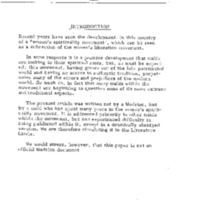
Introduction
Recent years have seen the development in this country of a "women's spirituality movement", which can be seen as a subsection of the women's liberation movement.
In some respects it is a positive development that maids are looking to their spiritual roots, but, as must be expected, this movement, having grown out of the late-patriarchal world and having no access to authentic tradition, perpetuates many of the errors and prejudices of the modern world. So much so, in fact, that many maids within the movement are beginning to question some of its more extreme antitraditional aspects.
The present article was written not by a Madrian, but by a maid who has spent many years in the women's spirituality movement. It is addressed primarily to other maids within the movement, but has experienced difficulty in being published within it, wxcept in a drastically abridged version. We are therefore circulating it in the Literature Circle.
We would stress, however, that this paper is not an official Madrian document.
The Hollow Tree
Feminist Spirituality or Sanctified Materialism?
A feminist friend recently averred (with some intensity) that there is "no dogma" in the feminist spirituality movement. I would like to use these words to pick up as a thread, to explain why I believe that all is not well with the movement.
Feminist religion as a whole does indeed claim to be non-dogmatic, in other words to be free from creeds, belief-systems or assertions of religious truth in general. A closer examination of the facts shows that this simply isn't so. The word 'dogma' means a principle of tenet, and on this ground alone the movement is dogmatic in fiercely holding to certain key tenets (e.g. the right of every woman to define her own spirituality and/or sexuality). Apart from this, the movement's dogma is often simply called something else ("spiritual affirmation" or "collective insight" etc.) as a way of making it sound acceptable. There is a very powerful dogma that the Goddess is the earth-goddess (or that the earth "is" the Goddess). You may say that this isn't a dogma, but just try questioning it, and see how far you get. If you as a woman in this movement don't believe in the earth-goddess, you will meet with strong negative reactions – disapproval, hostility, even abuse – no matter how gently or respectfully you express yourself. A recent pamphlet published by a sect called "The Church of the Goddess" contains this statement: "...the Goddess lives or dies as the earh lives or dies..." as dogmatic (and debatable!) a sentence as one ever did hear!
It is simply not logical to insist that dogma is bad, useless or invalid, because this is, in itself, a dogmatic statement – and therefore contradicts itself. Another self-contradictory statement often heard in 'womanspirit' circles is that there is not such thing as absolute truth – in other words, it is absolutely true that no such thing as absolute truth exists! This absurdity is usually taken for granted – and anyone who is daft enough to claim religious certainties is told that one cannot have them – that is, one can know for certain that one cannot know for certain!
All these things are interconnected – a mesh to shut out truth or light. Any movement describing itself as spiritual should, one would think, be deeply concerned with Truth – YES, with a capital T! But no – crucial questions, questions of the most fundamental kind, are dealt with byb refusing them as 'patriarchal'. The fact is that dogma – like everything else in the manifest world – amounts to a necessary evil, for we must speak and must communicate. Dogma has its right place as signpost, as key to a lock, as a window, or a road to a destination – but it also has its risks; the violent use of dogma to inflict sufferings on others, while the lazy mouth a form of words to aboid the work of understanding anything. We have gluttons – but do we then ban food?
It is not honest, and not the standard to be expected of Amazon women, to refuse to make the effort of discernment and to pretend that we have no dogma. Neither is it honest to refuse to examine basic assumptions. These almost all have their roots in the late-patriarchal-Protestant-tending-to-atheist world-view; the first principles of the 'womanspirit' movement come from relativism, scientism, materialism and atheism – worse still, some of them from very recent patriarchal ideas that were designed in hatred and rejection of all things Female and all things Spiritual! (Not so much woman-spirit as malematter, it seems). It is absurd to reject indiscriminately every aspect of the last three millenia of world religion (including such basic and perennial concepts as worship, prayer, the soul, and so forth) while accepting without question such things as left-wind politics, progress and evolution (to name but a few of the key dogmas of patriarchal atheism) and actually attempting to construct a spirituality upon such ideas. Of course, those who have been fooled by patriarchal false alternatives will only be able to see Fascism, right-wing social injustice and tub-thumping creationism as the alternatives to left-wing politics, progress and evolution respectively. I would have hoped that the essential creative vision of woman-kind could see past these crude masculine stupidities!
When we come to the Goddess Herself, who I hope is the centre of all our meaning and endeavour, we often find Her described (blasphemously, in my opinion) as a "concept", and one which is justified only insofar as it serves a sexual or political end. Now, either the Goddess is real, Reality itself, the Essence of all, the Self of selves, or She is nothing at all; a vaporization from the collective feminist brain, a projection of our psychology or of some political ideal; less in fact than the least of us, because a mere subjective fancy. Any refusal or reluctance to affirm the Goddess as the Absolute must reduce Her to a nonentity. If one does affirm the Goddess as the Absolute, one's 'sisters' in feminist religion are ready with dismissive quips about "Jehovah-in-drag", "God-in-skirts", or even "The Great Feminist in the Sky".
And what, precisely, is meant by "spirituality"? As expressed in most of the movement's literature, it appears to be compounded of psychological theorising (mostly in the style of Jung and so forth) and the flotsam-and-jetsam of patriarchal occultism (a dab of yoga here, a soupcon [sic] of Qabalah there, and rather a strong flavoring of Gardner's "witchcraft", or what he imagined to be the "old religion"). Underpinning the whole and in a sense knitting together a superficial 'diversity', we find the supposition that religion, the basic instinctual drives, the workings of the subconscious and sensations of pleasure are all somehow the same thing. This idea, confused though it may be, is passively accepted as received wisdom, and thereafter adhered to as a dogma. And hand-in-hand with it, we find the related idea that life, matter, this world PRECISELY AS THEY ARE constitute the only reality worth having. The consequences of this are devastating; a religion which leads one to strive towards nothing, and a moral complacency which is a refusal to recognise any difference between spiritual laziness and spiritual effort – it is all the same. We are all 'spiritual' already, without actually doing anything! And since everything already "is" the Goddess, one owes Her nothing; certainly not worship! This hedonistic gospel has nothing to recommend it except that it combines the most comfortable and easy advantages of both religion and atheism. Many of the women in the movement have been demonstrating – with the best of intentions in the world – at Greenham Common Air Base, protesting against the nuclear weapons which threaten the sacred and Goddess-given earth. Many of the same women see no conflict between their expressed Greenham desires to protect life, and the fact that they themselves poison their children in their own living-rooms by cigarette-smoking, as well as the fact that they believe in the destruction of life at its most vulnerable, in the womb. This moral contradiction is nothing more than may be expected from a philosophy of "this world only" and "freedom for all, but no responsibility", and so on and so forth. The so-called Goddess-religion of feminists offers absolutely nothing that may be distinguished from such amoral ways: there is in fact no "Goddess" to answer to; this is atheism and materialism, pure and simple – or, rather, corrupt and complicated!
Thus most of the womanspirit movement's literature is intensely sex-centred, pleasure-centred, even cynical of any moderation or restraint – it deals almost exclusively with material considerations as ends in themselves, as "already spiritual"; it offers virtually nothing of any wider perspective. Moral questions are ignored altogether, or dismissed as 'patriarchal' (a very useful dustbin, and saves one a lot of hard work and thought!). As as [sic] for MEANING and PURPOSE, these are never mentioned, except in connection with "cosmic cycles" and other hazy terms, thrown about with much ease and little knowledge.
It is little wonder that so much weight is given to those images from the past, from art and mythology, which portray a grotesque, demonic or tastelessly sexual female personage, taken to be a "dark side" of the Goddess, and interpreted as meaning that evil is "contained in" the Goddess Herself, or that promiscuity is a laudable and spiritual activity, or that evil and good are both the same thing. It is not that the women who treasure such diabolical images have no power of discernment, but that these images naturally express the demonic element in feminist spirituality; misguided women reach for them as surely as one reaches for a wooden spoon to stir soup. The constant efforts to prove that what is wrong is really right, make it necessary to refer to such evidence over and over again. The Goddess becomes the mother of lust, the mother of drugs, the mother of self-indulgence, the mother of fearful minds; the worshippers of this 'Goddess' ardently desire divine sanction for what is wrong; not receiving such an assurance from previous deities, they create a 'Goddess' who is part-evil, and then call that evil 'good'.
It is true that the growth of female spiritual activity is in itself a happy and hopeful thing, and that some women do (as individuals) have high ideals and real commitment, and are not afraid to think and to be scrupulous. But as for the movement as a movement, it is like a diseased tree – full of promise and springtime on the outside, but hollow within. It leans far too heavily on the modern, masculist world-view; it constantly fights shy of hard graft, and the profound spiritual questions, in particular the questions of Truth and Reality in their deepest and widest sense. It rejects all criticism, both internal and external, which indicates that women in the movement see it as an all-perfect and blameless thing, looking after itself without any attention or scrupulousness on their part. Worst of all, there is a sad lack of real reverence or humility in the face of the Sacred; in consequence the movement is impoverished in any truly spiritual sense.
ADDENDUM
A shorter version of this article was published in the American magazine Womanspirit. This version contained a few points not contained in the longer version which we reproduce here:
Another thing that disturbs me is an apparent unwillingness to see that much of the movement's philosophy comes from patriarchal roots. Many women, though rejecting most of the last three millenia of world religion (including the concepts of worship, the spirit, and so forth) accept without question left-wing political concepts, 'progress' and evolution. How can we safely construct our spirituality from such key concepts of patriarchal atheism?
I also question the possibility of common ground between matriarchy and anarchy. Women who look to deconstructed society ('matrianarchy') are adopting the Marxist notion of egalitarian primitives, without seeing that such societies, whether prehistoric or modern, matriarchal or patriarchal, are intensely disciplined and hierarchical. "Living in harmony with nature" and "natural cycles" does not mean "without structure" (which, by definition, would actually be "chaos").
After writing this article more than a year ago, I lost many friends, but during the same year some women who had disagreed violently came back and said, "You know, I have been thinking about this, and I agree with some of what you say." I wrote the article because I care passionately about the Goddess and women's spiritual concerns. I hope that even if you read it with anger, you will by-and-by find something in it that might be of value to you.
This last point is particularly interesting in view of the fact that the author herself originally held many of the opinions criticised in her article and even wrote a booklet in which they were set out. This book was sent to Lux Madriana for comment, and her reaction to our criticisms (many of which were substantially the same as those set out in the present article) was one of complete rejection. We were therefore both surprised and pleased to receive the article a year or so later.
We believe that wherever someone is prepared to give time and thought to the matter, traditional truth will inevitably prevail over modern fashion, simply because the one is true and the other false, and the soul, in her profoundest depths, cannot fail to recognise that. Why not try it yourself?
Introduction
Recent years have seen the development in this country of a "women's spirituality movement", which can be seen as a subsection of the women's liberation movement.
In some respects it is a positive development that maids are looking to their spiritual roots, but, as must be expected, this movement, having grown out of the late-patriarchal world and having no access to authentic tradition, perpetuates many of the errors and prejudices of the modern world. So much so, in fact, that many maids within the movement are beginning to question some of its more extreme antitraditional aspects.
The present article was written not by a Madrian, but by a maid who has spent many years in the women's spirituality movement. It is addressed primarily to other maids within the movement, but has experienced difficulty in being published within it, wxcept in a drastically abridged version. We are therefore circulating it in the Literature Circle.
We would stress, however, that this paper is not an official Madrian document.
The Hollow Tree
Feminist Spirituality or Sanctified Materialism?
A feminist friend recently averred (with some intensity) that there is "no dogma" in the feminist spirituality movement. I would like to use these words to pick up as a thread, to explain why I believe that all is not well with the movement.
Feminist religion as a whole does indeed claim to be non-dogmatic, in other words to be free from creeds, belief-systems or assertions of religious truth in general. A closer examination of the facts shows that this simply isn't so. The word 'dogma' means a principle of tenet, and on this ground alone the movement is dogmatic in fiercely holding to certain key tenets (e.g. the right of every woman to define her own spirituality and/or sexuality). Apart from this, the movement's dogma is often simply called something else ("spiritual affirmation" or "collective insight" etc.) as a way of making it sound acceptable. There is a very powerful dogma that the Goddess is the earth-goddess (or that the earth "is" the Goddess). You may say that this isn't a dogma, but just try questioning it, and see how far you get. If you as a woman in this movement don't believe in the earth-goddess, you will meet with strong negative reactions – disapproval, hostility, even abuse – no matter how gently or respectfully you express yourself. A recent pamphlet published by a sect called "The Church of the Goddess" contains this statement: "...the Goddess lives or dies as the earh lives or dies..." as dogmatic (and debatable!) a sentence as one ever did hear!
It is simply not logical to insist that dogma is bad, useless or invalid, because this is, in itself, a dogmatic statement – and therefore contradicts itself. Another self-contradictory statement often heard in 'womanspirit' circles is that there is not such thing as absolute truth – in other words, it is absolutely true that no such thing as absolute truth exists! This absurdity is usually taken for granted – and anyone who is daft enough to claim religious certainties is told that one cannot have them – that is, one can know for certain that one cannot know for certain!
All these things are interconnected – a mesh to shut out truth or light. Any movement describing itself as spiritual should, one would think, be deeply concerned with Truth – YES, with a capital T! But no – crucial questions, questions of the most fundamental kind, are dealt with byb refusing them as 'patriarchal'. The fact is that dogma – like everything else in the manifest world – amounts to a necessary evil, for we must speak and must communicate. Dogma has its right place as signpost, as key to a lock, as a window, or a road to a destination – but it also has its risks; the violent use of dogma to inflict sufferings on others, while the lazy mouth a form of words to aboid the work of understanding anything. We have gluttons – but do we then ban food?
It is not honest, and not the standard to be expected of Amazon women, to refuse to make the effort of discernment and to pretend that we have no dogma. Neither is it honest to refuse to examine basic assumptions. These almost all have their roots in the late-patriarchal-Protestant-tending-to-atheist world-view; the first principles of the 'womanspirit' movement come from relativism, scientism, materialism and atheism – worse still, some of them from very recent patriarchal ideas that were designed in hatred and rejection of all things Female and all things Spiritual! (Not so much woman-spirit as malematter, it seems). It is absurd to reject indiscriminately every aspect of the last three millenia of world religion (including such basic and perennial concepts as worship, prayer, the soul, and so forth) while accepting without question such things as left-wind politics, progress and evolution (to name but a few of the key dogmas of patriarchal atheism) and actually attempting to construct a spirituality upon such ideas. Of course, those who have been fooled by patriarchal false alternatives will only be able to see Fascism, right-wing social injustice and tub-thumping creationism as the alternatives to left-wing politics, progress and evolution respectively. I would have hoped that the essential creative vision of woman-kind could see past these crude masculine stupidities!
When we come to the Goddess Herself, who I hope is the centre of all our meaning and endeavour, we often find Her described (blasphemously, in my opinion) as a "concept", and one which is justified only insofar as it serves a sexual or political end. Now, either the Goddess is real, Reality itself, the Essence of all, the Self of selves, or She is nothing at all; a vaporization from the collective feminist brain, a projection of our psychology or of some political ideal; less in fact than the least of us, because a mere subjective fancy. Any refusal or reluctance to affirm the Goddess as the Absolute must reduce Her to a nonentity. If one does affirm the Goddess as the Absolute, one's 'sisters' in feminist religion are ready with dismissive quips about "Jehovah-in-drag", "God-in-skirts", or even "The Great Feminist in the Sky".
And what, precisely, is meant by "spirituality"? As expressed in most of the movement's literature, it appears to be compounded of psychological theorising (mostly in the style of Jung and so forth) and the flotsam-and-jetsam of patriarchal occultism (a dab of yoga here, a soupcon [sic] of Qabalah there, and rather a strong flavoring of Gardner's "witchcraft", or what he imagined to be the "old religion"). Underpinning the whole and in a sense knitting together a superficial 'diversity', we find the supposition that religion, the basic instinctual drives, the workings of the subconscious and sensations of pleasure are all somehow the same thing. This idea, confused though it may be, is passively accepted as received wisdom, and thereafter adhered to as a dogma. And hand-in-hand with it, we find the related idea that life, matter, this world PRECISELY AS THEY ARE constitute the only reality worth having. The consequences of this are devastating; a religion which leads one to strive towards nothing, and a moral complacency which is a refusal to recognise any difference between spiritual laziness and spiritual effort – it is all the same. We are all 'spiritual' already, without actually doing anything! And since everything already "is" the Goddess, one owes Her nothing; certainly not worship! This hedonistic gospel has nothing to recommend it except that it combines the most comfortable and easy advantages of both religion and atheism. Many of the women in the movement have been demonstrating – with the best of intentions in the world – at Greenham Common Air Base, protesting against the nuclear weapons which threaten the sacred and Goddess-given earth. Many of the same women see no conflict between their expressed Greenham desires to protect life, and the fact that they themselves poison their children in their own living-rooms by cigarette-smoking, as well as the fact that they believe in the destruction of life at its most vulnerable, in the womb. This moral contradiction is nothing more than may be expected from a philosophy of "this world only" and "freedom for all, but no responsibility", and so on and so forth. The so-called Goddess-religion of feminists offers absolutely nothing that may be distinguished from such amoral ways: there is in fact no "Goddess" to answer to; this is atheism and materialism, pure and simple – or, rather, corrupt and complicated!
Thus most of the womanspirit movement's literature is intensely sex-centred, pleasure-centred, even cynical of any moderation or restraint – it deals almost exclusively with material considerations as ends in themselves, as "already spiritual"; it offers virtually nothing of any wider perspective. Moral questions are ignored altogether, or dismissed as 'patriarchal' (a very useful dustbin, and saves one a lot of hard work and thought!). As as [sic] for MEANING and PURPOSE, these are never mentioned, except in connection with "cosmic cycles" and other hazy terms, thrown about with much ease and little knowledge.
It is little wonder that so much weight is given to those images from the past, from art and mythology, which portray a grotesque, demonic or tastelessly sexual female personage, taken to be a "dark side" of the Goddess, and interpreted as meaning that evil is "contained in" the Goddess Herself, or that promiscuity is a laudable and spiritual activity, or that evil and good are both the same thing. It is not that the women who treasure such diabolical images have no power of discernment, but that these images naturally express the demonic element in feminist spirituality; misguided women reach for them as surely as one reaches for a wooden spoon to stir soup. The constant efforts to prove that what is wrong is really right, make it necessary to refer to such evidence over and over again. The Goddess becomes the mother of lust, the mother of drugs, the mother of self-indulgence, the mother of fearful minds; the worshippers of this 'Goddess' ardently desire divine sanction for what is wrong; not receiving such an assurance from previous deities, they create a 'Goddess' who is part-evil, and then call that evil 'good'.
It is true that the growth of female spiritual activity is in itself a happy and hopeful thing, and that some women do (as individuals) have high ideals and real commitment, and are not afraid to think and to be scrupulous. But as for the movement as a movement, it is like a diseased tree – full of promise and springtime on the outside, but hollow within. It leans far too heavily on the modern, masculist world-view; it constantly fights shy of hard graft, and the profound spiritual questions, in particular the questions of Truth and Reality in their deepest and widest sense. It rejects all criticism, both internal and external, which indicates that women in the movement see it as an all-perfect and blameless thing, looking after itself without any attention or scrupulousness on their part. Worst of all, there is a sad lack of real reverence or humility in the face of the Sacred; in consequence the movement is impoverished in any truly spiritual sense.
ADDENDUM
A shorter version of this article was published in the American magazine Womanspirit. This version contained a few points not contained in the longer version which we reproduce here:
Another thing that disturbs me is an apparent unwillingness to see that much of the movement's philosophy comes from patriarchal roots. Many women, though rejecting most of the last three millenia of world religion (including the concepts of worship, the spirit, and so forth) accept without question left-wing political concepts, 'progress' and evolution. How can we safely construct our spirituality from such key concepts of patriarchal atheism?
I also question the possibility of common ground between matriarchy and anarchy. Women who look to deconstructed society ('matrianarchy') are adopting the Marxist notion of egalitarian primitives, without seeing that such societies, whether prehistoric or modern, matriarchal or patriarchal, are intensely disciplined and hierarchical. "Living in harmony with nature" and "natural cycles" does not mean "without structure" (which, by definition, would actually be "chaos").
After writing this article more than a year ago, I lost many friends, but during the same year some women who had disagreed violently came back and said, "You know, I have been thinking about this, and I agree with some of what you say." I wrote the article because I care passionately about the Goddess and women's spiritual concerns. I hope that even if you read it with anger, you will by-and-by find something in it that might be of value to you.
This last point is particularly interesting in view of the fact that the author herself originally held many of the opinions criticised in her article and even wrote a booklet in which they were set out. This book was sent to Lux Madriana for comment, and her reaction to our criticisms (many of which were substantially the same as those set out in the present article) was one of complete rejection. We were therefore both surprised and pleased to receive the article a year or so later.
We believe that wherever someone is prepared to give time and thought to the matter, traditional truth will inevitably prevail over modern fashion, simply because the one is true and the other false, and the soul, in her profoundest depths, cannot fail to recognise that. Why not try it yourself?
Original Format
loose leaf, typewritten (8pp.)
Files
Collection
Citation
“The Hollow Tree,” Digital Library for Filianic Studies, accessed September 4, 2026, https://www.filianicstudies.org/cms/items/show/33.