On Going All the Way
Dublin Core
Title
On Going All the Way
Description
An essay concerning the absolute nature of religious claims in general, and the impossibility of "relative importance" in religious matters.
Source
Personal collection of David Kay.
Publisher
Madrian Literature Circle
Date
c. 1980
Language
English
Type
Text
Text Item Type Metadata
Text
On Going all the Way
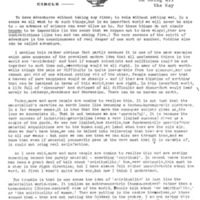
To have adventures without taking any risks; to swim without getting wet. In a sense we all want to do such things, but in an imperfect world we will never be able to – no advance of science can ever allow us to. For these things do not simply happen to be impossible (in the sense that we happen not to have wings), they are contradictions (like two and two making five.) The very essence of the spirit of adventure is the consciousness of real danger of one sort or another. Nothing else can be called adventure.
I mention this rather obvious fact partly because it is one of the many examples which make nonsense of the prevalent modern idea that all unpleasant things in the world are 'accidental' and that if enough scientists and politicians could be got together to sort them out, everything would be all right. In many of the most worthwhile things the pain or difficulty is quite inseparable from the pleasure, and one cannot get rid of one without getting rid of the other. People sometimes say that a heaven of pure happiness would be ghastly – and if they are thinking of anything that can be imagined in terms of this world, they are right. In this imperfect world, a life full of 'pleasures' and stripped of all difficulty and discomfort would lead merely to lethargy, decadence and depression. There can be no heaven on earth.
Today, more and more people are coming to realise this. It is not just that the materialist's paradise on earth looks like becoming a techno-bureaucratic nightmare. In a far deeper sense, it is true that the more the consumer society gives us, the less we appreciate it. That is not because we are 'ungrateful'. It is because the very success of industrial-materialism (even a very limited success) gives us a sample of the goods. We see how limited, how sterile, how fundamentally unsatisfying material acquisitions are to the human soul, at least when they are the sole aim. When we don't have them, we can be talked into believing that they are the answer to all our wants – but once we can see them we can also see though them, and we know that even if material prosperity gave us the very most that it is capable of, it could not bring real satisfaction.
As I have said, more and more people are coming to realise this and are seeking something beyond the purely material – something 'spiritual'. In recent years there has been a great deal of talk about 'spirituality'. Now, very obviously, this must be a step in the right direction; but I have always felt rather uncomfortable about the word. At first I wasn't quite sure why, but now I think I understand.
The trouble is that in one sense the idea of 'spirituality' is just like the materialist world-view. It implies an anthropocentirc (human-centred) rather than a theacentric (Divine-centred) view of the world. People talk about 'my spirituality', or 'the spirituality of women'. They are putting in the centre themselves, or those around them – they are not putting the Goddess in the centre. I am not saying this cannot lead on to better things – very often it does. But all too often it is a sort of escape-route. It allows a little other-worldly perfume into the disinfected corridors of materialism while ducking the issue of a genuine religious commitment.
What is wrong with this is that it is simply a circular detour which leads us in the end back to where we started. Materialism is not sterile because is is materialism. Materialism is simply one way of avoiding the overwhelming challenge of the Absolute – the love of the Goddess which demands not less than everything. The sterility comes from that avoidance. But when 'spirituality' just becomes a more roundabout way of making the same avoidance, it quickly returns to the same sterility. That is why vaguely 'spiritual' movements always have such a very high membership turnover and a very short active life.
The utter anthropocentricity of much (though not all) the talk about 'spirituality' is epitomised in such phrases as "we should explore our spirituality" – as though spirituality were just another human attribute like, say, musicality. Not spirituality, if it means anything, means the faculty through which we perceive the Divine. Imagine coming upon a breathtaking and awe-inspiring view of a mountain range, and try to imagine a person who, instead of saying "Look at that!" would say "explore your eye-sight." All the attention is shifted from the perceived to the perceiver.
The idea behind this is the view of spirituality as one small department of the whole human makeup, and 'religion' as one small department of the whole of life.
Now to a Madrian, this is quite wrong. 'Religion' is not a small department of life – rather, the whole of human life as we know it is but one small department of the vast pattern of intelligent life, spanning the whole universe (both physical and non-physical) which is shaped and moulded solely by the varying levels of relationship to the Absolute Being Who is Creatrix of it all, and whose one true aim is to return to perfect union with Her. The word we humans give to the pursuit of this aim is 'religion'.
You may disagree with this. You may reject all the claims of religion in general and Madrianism in particular. But there can be no doubt about what those claims are: religion claims to tell us about the origin, the meaning and the end of life – what the universe is, and what it is for, and to give real knowledge about the Absolute Principle of the universe and our relationship with Her.
Those claims can only be one of two things. Either that are true, or they are worthless nonsense. They cannot be anything else. Either religion is the one most important thing on earth – or anywhere else, for that matter – or else it is completely unimportant. The vague idea that religion is all right, but one shouldn't carry it too far, is nonsensical. Religion is either all-important or unimportant. The one thing it cannot be is relatively important.
The demand of our Lady is both beautiful and terrible in its simplicity: "Give your whole self to Me." She is the one true home of the human soul, and without Her we must suffer perpetual dissatisfaction. The only completion of the soul is union with Her.
Because we have turned from Her at the dawn of time – the beginning of our stream of incarnations – we are imperfect creatures, mixed of good and bad, true and false. And the false self – that part of us which turns from Her (the word selfish means 'concerned with the false self') – has a real terror and revulsion from turning back to Her. To love the Goddess is continually to conquer the false self (literally 'self'-control) which is often very hard.
Faced with the sterility of materialism, it is a very natural desire to wish to reject the sterility without making any real self-commitment – to have adventures without taking risks, to swim without getting wet. For the sterility and the lack of commitment are one, and the difficulty of disciplining the false self and the joy (far deeper than mere 'pleasure') are alike one, while we are still imperfect. Yet it is natural to try; and this is one of the innumerable subtle ploys which the false self will use to lead us back into the spiritual darkness in which it thrives.
A recent letter from an intelligent and sensitive maid contained these words; it is very typical:–
"The need for women to recognise and develop their spirituality is vital. What I can't go along with is worship – though I believe in a devout attitude to life."
One can almost see the false self struggling with the true. What is this abstract 'life' to which we should have a devout attitude? And if we will not worship, what does being 'devout' mean?
But behind these words we see the very understandable cry of the soul, torn between the true and false self: "I realise the need to seek the Divine and to love Her – but I want to keep my independence. I would feel so much more comfortable with vague abstractions about life than with the living Goddess and an absolute demand."
Related to this is the temptation to which those groups have succumbed which began by seeking the Goddess, and have confined themselves to the study of ancient texts – they have reduced Her to an academic 'subject' and so side-stepped the issue of real commitment.
I am not intending to attack anyone, for heaven knows, my own faults are great enough. But the pitfalls of which I have spoken are perhaps the most dangerous of all, for they do not merely hamper us on our way, they lead us down a side alley before we have even begun.
The total relinquishment of the self to the all-consuming love of the Goddess is the most difficult and the most beautiful of all possible acts. Few of us will achieve it in this life, for few of us are heras [helati]. But once we have made the first few faltering steps towards Her, our whole view of the world must change. It must stop being human-centred and start being Divine-centred. For an anthropocentric religion is no religion at all, however much easier it is for our materialist-conditioned minds and more comfortable for our pride. Anyone who is looking for easy or comfortable religion would do better to go to any modern 'liberal' Christian church.
That is why she will find it empty.
First published in The Coming Age No. 3
To have adventures without taking any risks; to swim without getting wet. In a sense we all want to do such things, but in an imperfect world we will never be able to – no advance of science can ever allow us to. For these things do not simply happen to be impossible (in the sense that we happen not to have wings), they are contradictions (like two and two making five.) The very essence of the spirit of adventure is the consciousness of real danger of one sort or another. Nothing else can be called adventure.
I mention this rather obvious fact partly because it is one of the many examples which make nonsense of the prevalent modern idea that all unpleasant things in the world are 'accidental' and that if enough scientists and politicians could be got together to sort them out, everything would be all right. In many of the most worthwhile things the pain or difficulty is quite inseparable from the pleasure, and one cannot get rid of one without getting rid of the other. People sometimes say that a heaven of pure happiness would be ghastly – and if they are thinking of anything that can be imagined in terms of this world, they are right. In this imperfect world, a life full of 'pleasures' and stripped of all difficulty and discomfort would lead merely to lethargy, decadence and depression. There can be no heaven on earth.
Today, more and more people are coming to realise this. It is not just that the materialist's paradise on earth looks like becoming a techno-bureaucratic nightmare. In a far deeper sense, it is true that the more the consumer society gives us, the less we appreciate it. That is not because we are 'ungrateful'. It is because the very success of industrial-materialism (even a very limited success) gives us a sample of the goods. We see how limited, how sterile, how fundamentally unsatisfying material acquisitions are to the human soul, at least when they are the sole aim. When we don't have them, we can be talked into believing that they are the answer to all our wants – but once we can see them we can also see though them, and we know that even if material prosperity gave us the very most that it is capable of, it could not bring real satisfaction.
As I have said, more and more people are coming to realise this and are seeking something beyond the purely material – something 'spiritual'. In recent years there has been a great deal of talk about 'spirituality'. Now, very obviously, this must be a step in the right direction; but I have always felt rather uncomfortable about the word. At first I wasn't quite sure why, but now I think I understand.
The trouble is that in one sense the idea of 'spirituality' is just like the materialist world-view. It implies an anthropocentirc (human-centred) rather than a theacentric (Divine-centred) view of the world. People talk about 'my spirituality', or 'the spirituality of women'. They are putting in the centre themselves, or those around them – they are not putting the Goddess in the centre. I am not saying this cannot lead on to better things – very often it does. But all too often it is a sort of escape-route. It allows a little other-worldly perfume into the disinfected corridors of materialism while ducking the issue of a genuine religious commitment.
What is wrong with this is that it is simply a circular detour which leads us in the end back to where we started. Materialism is not sterile because is is materialism. Materialism is simply one way of avoiding the overwhelming challenge of the Absolute – the love of the Goddess which demands not less than everything. The sterility comes from that avoidance. But when 'spirituality' just becomes a more roundabout way of making the same avoidance, it quickly returns to the same sterility. That is why vaguely 'spiritual' movements always have such a very high membership turnover and a very short active life.
The utter anthropocentricity of much (though not all) the talk about 'spirituality' is epitomised in such phrases as "we should explore our spirituality" – as though spirituality were just another human attribute like, say, musicality. Not spirituality, if it means anything, means the faculty through which we perceive the Divine. Imagine coming upon a breathtaking and awe-inspiring view of a mountain range, and try to imagine a person who, instead of saying "Look at that!" would say "explore your eye-sight." All the attention is shifted from the perceived to the perceiver.
The idea behind this is the view of spirituality as one small department of the whole human makeup, and 'religion' as one small department of the whole of life.
Now to a Madrian, this is quite wrong. 'Religion' is not a small department of life – rather, the whole of human life as we know it is but one small department of the vast pattern of intelligent life, spanning the whole universe (both physical and non-physical) which is shaped and moulded solely by the varying levels of relationship to the Absolute Being Who is Creatrix of it all, and whose one true aim is to return to perfect union with Her. The word we humans give to the pursuit of this aim is 'religion'.
You may disagree with this. You may reject all the claims of religion in general and Madrianism in particular. But there can be no doubt about what those claims are: religion claims to tell us about the origin, the meaning and the end of life – what the universe is, and what it is for, and to give real knowledge about the Absolute Principle of the universe and our relationship with Her.
Those claims can only be one of two things. Either that are true, or they are worthless nonsense. They cannot be anything else. Either religion is the one most important thing on earth – or anywhere else, for that matter – or else it is completely unimportant. The vague idea that religion is all right, but one shouldn't carry it too far, is nonsensical. Religion is either all-important or unimportant. The one thing it cannot be is relatively important.
The demand of our Lady is both beautiful and terrible in its simplicity: "Give your whole self to Me." She is the one true home of the human soul, and without Her we must suffer perpetual dissatisfaction. The only completion of the soul is union with Her.
Because we have turned from Her at the dawn of time – the beginning of our stream of incarnations – we are imperfect creatures, mixed of good and bad, true and false. And the false self – that part of us which turns from Her (the word selfish means 'concerned with the false self') – has a real terror and revulsion from turning back to Her. To love the Goddess is continually to conquer the false self (literally 'self'-control) which is often very hard.
Faced with the sterility of materialism, it is a very natural desire to wish to reject the sterility without making any real self-commitment – to have adventures without taking risks, to swim without getting wet. For the sterility and the lack of commitment are one, and the difficulty of disciplining the false self and the joy (far deeper than mere 'pleasure') are alike one, while we are still imperfect. Yet it is natural to try; and this is one of the innumerable subtle ploys which the false self will use to lead us back into the spiritual darkness in which it thrives.
A recent letter from an intelligent and sensitive maid contained these words; it is very typical:–
"The need for women to recognise and develop their spirituality is vital. What I can't go along with is worship – though I believe in a devout attitude to life."
One can almost see the false self struggling with the true. What is this abstract 'life' to which we should have a devout attitude? And if we will not worship, what does being 'devout' mean?
But behind these words we see the very understandable cry of the soul, torn between the true and false self: "I realise the need to seek the Divine and to love Her – but I want to keep my independence. I would feel so much more comfortable with vague abstractions about life than with the living Goddess and an absolute demand."
Related to this is the temptation to which those groups have succumbed which began by seeking the Goddess, and have confined themselves to the study of ancient texts – they have reduced Her to an academic 'subject' and so side-stepped the issue of real commitment.
I am not intending to attack anyone, for heaven knows, my own faults are great enough. But the pitfalls of which I have spoken are perhaps the most dangerous of all, for they do not merely hamper us on our way, they lead us down a side alley before we have even begun.
The total relinquishment of the self to the all-consuming love of the Goddess is the most difficult and the most beautiful of all possible acts. Few of us will achieve it in this life, for few of us are heras [helati]. But once we have made the first few faltering steps towards Her, our whole view of the world must change. It must stop being human-centred and start being Divine-centred. For an anthropocentric religion is no religion at all, however much easier it is for our materialist-conditioned minds and more comfortable for our pride. Anyone who is looking for easy or comfortable religion would do better to go to any modern 'liberal' Christian church.
That is why she will find it empty.
First published in The Coming Age No. 3
Original Format
loose leaf, typewritten (3pp.)
Files
Collection
Citation
“On Going All the Way,” Digital Library for Filianic Studies, accessed September 4, 2026, https://www.filianicstudies.org/cms/items/show/23.