On Obedience
Dublin Core
Title
On Obedience
Subject
Obedience
Description
A calligraphic composition by Sr. Alethea on the significance and importance of obedience to one's spiritual mistress.
Creator
Sr. Alethea
Source
Personal collection of David Kay.
Publisher
Madrian Literature Circle
Date
c. 1980
Language
English
Type
Text
Text Item Type Metadata
Text
Obedience
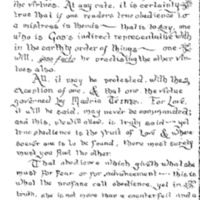
One could perhaps make a case for declaring that obedience is the first of all the virtues. At any rate, it is certainly true that if one renders true obedience to a mistress in themis [thamë] – that is to say, one who is God's indirect representative within the earthly order of things – one will, ipso facto be practising the other virtues also.
All, it may be protested, with the exception of one, & that one, the virtue governed by Madria Tethys [Sai Sushuri]. For Love, it will be said, may never be commanded; and this, we will allow, is truly said – yet true obedience is the fruit of Love & wheresoever one is to be found, there most surely you find the other.
That obedience which giveth what she must for fear or for advancement – this is what the profane call obedience, yet in truth, she is not more than a counterfeit and a false adulteress. For true obedience binds not the body only but the soul, & tho' we may like the task we are set to no better than the willow-rod that is set upon our shoulders, yet we would not have it any wise other than as our mistress wills it.
For if we love our Lady, then we willingly obey Her, & in obeying Her, obey also the Ranya that She has set over us on the earth. Obedience is the chain that bindeth earth to Heaven, & tho' there be them that say they will love but not obey, yet in such case the love endures not long, & this is proven both by the words of holy Scripture & by the examples of maids & of nations.
So truly we may say, if obedience be not the first among the vritues, yet Love is, & obedience is not the fruit of love merely, but her daughter – & like to God's own beloved Daughter [sign of pentagram], is not her child only, but her very self.
Writ by the maid Alethea in loving obedience to her mistress.
One could perhaps make a case for declaring that obedience is the first of all the virtues. At any rate, it is certainly true that if one renders true obedience to a mistress in themis [thamë] – that is to say, one who is God's indirect representative within the earthly order of things – one will, ipso facto be practising the other virtues also.
All, it may be protested, with the exception of one, & that one, the virtue governed by Madria Tethys [Sai Sushuri]. For Love, it will be said, may never be commanded; and this, we will allow, is truly said – yet true obedience is the fruit of Love & wheresoever one is to be found, there most surely you find the other.
That obedience which giveth what she must for fear or for advancement – this is what the profane call obedience, yet in truth, she is not more than a counterfeit and a false adulteress. For true obedience binds not the body only but the soul, & tho' we may like the task we are set to no better than the willow-rod that is set upon our shoulders, yet we would not have it any wise other than as our mistress wills it.
For if we love our Lady, then we willingly obey Her, & in obeying Her, obey also the Ranya that She has set over us on the earth. Obedience is the chain that bindeth earth to Heaven, & tho' there be them that say they will love but not obey, yet in such case the love endures not long, & this is proven both by the words of holy Scripture & by the examples of maids & of nations.
So truly we may say, if obedience be not the first among the vritues, yet Love is, & obedience is not the fruit of love merely, but her daughter – & like to God's own beloved Daughter [sign of pentagram], is not her child only, but her very self.
Writ by the maid Alethea in loving obedience to her mistress.
Original Format
loose leaf, handwritten (3pp.)
Files
Collection
Citation
Sr. Alethea, “On Obedience,” Digital Library for Filianic Studies, accessed September 4, 2026, https://www.filianicstudies.org/cms/items/show/21.